A&h Kosher Beef Hot Dogs Peanut Allergy
| A | |
|---|---|
| A a ɑ | |
| (See beneath) | |
 | |
| Usage | |
| Writing organisation | Latin script |
| Type | Alphabet |
| Linguistic communication of origin | Latin linguistic communication |
| Phonetic usage |
|
| Unicode codepoint | U+0041, U+0061 |
| Alphabetical position | 1 Numerical value: ane |
| History | |
| Evolution |
|
| Time period | ~-700 to present |
| Descendants |
|
| Sisters |
|
| Variations | (See below) |
| Other | |
| Other letters commonly used with | a(x), ae, eau |
| Associated numbers | 1 |


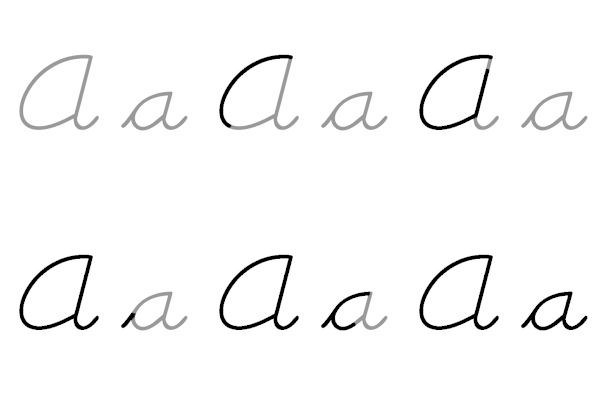
A, or a, is the first letter and the starting time vowel of the modern English alphabet and the ISO basic Latin alphabet.[1] [two] Its name in English is a (pronounced ), plural aes.[nb ane] It is similar in shape to the Ancient Greek letter blastoff, from which it derives.[three] The uppercase version consists of the two slanting sides of a triangle, crossed in the middle past a horizontal bar. The lowercase version can be written in ii forms: the double-storey a and single-storey ɑ. The latter is commonly used in handwriting and fonts based on information technology, especially fonts intended to exist read by children, and is too establish in italic type.
In the English grammar, "a", and its variant "an", are indefinite articles.
History
| Egyptian | Proto-Sinaitic ʾalp | Proto-Canaanite | Phoenician aleph | Greek Alpha | Etruscan A | Latin/ Cyrillic A | Greek Uncial | Latin 300 Advertizement Uncial | |
|---|---|---|---|---|---|---|---|---|---|
 |  |  |  |  |  |  |  |  | |
The earliest certain ancestor of "A" is aleph (as well written 'aleph), the start letter of the Phoenician alphabet,[4] which consisted entirely of consonants (for that reason, it is too called an abjad to distinguish information technology from a truthful alphabet). In plow, the antecedent of aleph may have been a pictogram of an ox caput in proto-Sinaitic script[v] influenced by Egyptian hieroglyphs, styled as a triangular head with two horns extended.
When the ancient Greeks adopted the alphabet, they had no employ for a letter to represent the glottal cease—the consonant sound that the letter of the alphabet denoted in Phoenician and other Semitic languages, and that was the offset phoneme of the Phoenician pronunciation of the letter of the alphabet—and so they used their version of the sign to represent the vowel /a/, and called it by the similar name of alpha. In the primeval Greek inscriptions afterward the Greek Dark Ages, dating to the 8th century BC, the letter rests upon its side, simply in the Greek alphabet of later times it generally resembles the modern capital letter letter, although many local varieties can exist distinguished by the shortening of 1 leg, or past the angle at which the cross line is set.
The Etruscans brought the Greek alphabet to their civilization in the Italian Peninsula and left the letter unchanged. The Romans later adopted the Etruscan alphabet to write the Latin linguistic communication, and the resulting letter was preserved in the Latin alphabet that would come to be used to write many languages, including English.
Typographic variants

Different glyphs of the lowercase letter A.
During Roman times, at that place were many variant forms of the letter "A". First was the monumental or lapidary fashion, which was used when inscribing on stone or other "permanent" media. In that location was also a cursive style used for everyday or utilitarian writing, which was washed on more perishable surfaces. Due to the "perishable" nature of these surfaces, there are non equally many examples of this style equally at that place are of the awe-inspiring, only in that location are notwithstanding many surviving examples of unlike types of cursive, such as uppercase cursive, minuscule cursive, and semicursive minuscule. Variants also existed that were intermediate between the monumental and cursive styles. The known variants include the early semi-uncial, the uncial, and the afterwards semi-uncial.[half dozen]

At the cease of the Roman Empire (5th century AD), several variants of the cursive minuscule developed through Western Europe. Among these were the semicursive minuscule of Italy, the Merovingian script in France, the Visigothic script in Spain, and the Insular or Anglo-Irish gaelic semi-uncial or Anglo-Saxon capital letter of Great United kingdom of great britain and northern ireland. Past the 9th century, the Caroline script, which was very similar to the present-twenty-four hour period grade, was the principal grade used in volume-making, before the advent of the press printing. This form was derived through a combining of prior forms.[6]
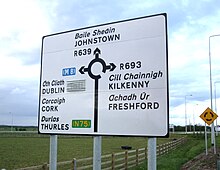
Road sign in Ireland, showing the Irish gaelic "Latin alpha" form of "a" in lower and upper instance forms.
15th-century Italia saw the formation of the two main variants that are known today. These variants, the Italic and Roman forms, were derived from the Caroline Script version. The Italic form, also called script a, is used in almost current handwriting; it consists of a circle and vertical stroke on the right ("ɑ"). This slowly developed from the fifth-century course resembling the Greek letter of the alphabet tau in the hands of medieval Irish gaelic and English language writers.[iv] The Roman form is used in well-nigh printed fabric; it consists of a modest loop with an arc over it ("a").[6] Both derive from the majuscule (upper-case letter) course. In Greek handwriting, it was common to join the left leg and horizontal stroke into a single loop, as demonstrated by the uncial version shown. Many fonts and so made the right leg vertical. In some of these, the serif that began the right leg stroke developed into an arc, resulting in the printed form, while in others it was dropped, resulting in the mod handwritten form. Graphic designers refer to the Italic and Roman forms equally "unmarried decker a" and "double decker a" respectively.
Italic type is commonly used to mark emphasis or more by and large to distinguish ane part of a text from the rest (gear up in Roman type). There are some other cases aside from italic type where script a ("ɑ"), as well called Latin blastoff, is used in contrast with Latin "a" (such as in the International Phonetic Alphabet).
Use in writing systems

Pronunciation of the name of the letter of the alphabet ⟨a⟩ in European languages, notation that /a/ and /aː/ tin can differ phonetically between [a], [ä], [æ] and [ɑ] depending on the linguistic communication.
English
In modernistic English language orthography, the letter of the alphabet ⟨a⟩ represents at to the lowest degree vii different vowel sounds:
- the near-open front unrounded vowel /æ/ as in pad;
- the open back unrounded vowel /ɑː/ as in father, which is closer to its original Latin and Greek sound;[5]
- the diphthong /eɪ/ equally in ace and major (usually when ⟨a⟩ is followed past 1, or occasionally 2, consonants and then another vowel letter of the alphabet) – this results from Middle English lengthening followed past the Great Vowel Shift;
- the modified form of the higher up sound that occurs before ⟨r⟩, equally in foursquare and Mary;
- the rounded vowel of water;
- the shorter rounded vowel (not nowadays in General American) in was and what;[4]
- a schwa, in many unstressed syllables, as in nigh, comma, solar.
The double ⟨aa⟩ sequence does not occur in native English words, just is found in some words derived from foreign languages such as Aaron and aardvark.[7] Even so, ⟨a⟩ occurs in many common digraphs, all with their own sound or sounds, especially ⟨ai⟩, ⟨au⟩, ⟨aw⟩, ⟨ay⟩, ⟨ea⟩ and ⟨oa⟩.
⟨a⟩ is the 3rd-near-unremarkably used letter in English (after ⟨due east⟩ and ⟨t⟩) and French, the second most common in Spanish, and the most common in Portuguese. About 8.167% of letters used in English texts tend to be ⟨a⟩;[eight] the number is around seven.636% in French,[9] 11.525% in Spanish,[ten] and 14.634% for Portuguese.[11]
Other languages
In most languages that use the Latin alphabet, ⟨a⟩ denotes an open unrounded vowel, such every bit /a/, /ä/, or /ɑ/. An exception is Saanich, in which ⟨a⟩ (and the glyph Á) stands for a shut-mid forepart unrounded vowel /e/.
Other systems
In phonetic and phonemic notation:
- in the International Phonetic Alphabet, ⟨a⟩ is used for the open forepart unrounded vowel, ⟨ä⟩ is used for the open up cardinal unrounded vowel, and ⟨ɑ⟩ is used for the open up back unrounded vowel.
- in X-SAMPA, ⟨a⟩ is used for the open up front end unrounded vowel and ⟨A⟩ is used for the open back unrounded vowel.
Other uses
In algebra, the letter a forth with various other letters of the alphabet is oft used to denote a variable, with diverse conventional meanings in different areas of mathematics. Moreover, in 1637, René Descartes "invented the convention of representing unknowns in equations by ten, y, and z, and knowns by a, b, and c",[12] and this convention is even so frequently followed, especially in elementary algebra.
In geometry, capital A, B, C etc. are used to denote segments, lines, rays, etc.[6] A capital A is also typically used as one of the letters to correspond an angle in a triangle, the lowercase a representing the side opposite angle A.[5]
"A" is often used to denote something or someone of a amend or more prestigious quality or status: A−, A or A+, the best class that can be assigned by teachers for students' schoolwork; "A grade" for make clean restaurants; A-listing celebrities, etc. Such associations can have a motivating effect, equally exposure to the letter of the alphabet A has been plant to improve performance, when compared with other letters.[13]
"A" is used equally a prefix on some words, such as asymmetry, to hateful "not" or "without" (from Greek).
In English grammar, "a", and its variant "an", is an indefinite article, used to innovate noun phrases.
Finally, the alphabetic character A is used to denote size, equally in a narrow size shoe,[5] or a small-scale cup size in a brassiere.[14]
- Æ æ : Latin AE ligature
- A with diacritics: Å å Ǻ ǻ Ḁ ḁ ẚ Ă ă Ặ ặ Ắ ắ Ằ ằ Ẳ ẳ Ẵ ẵ Ȃ ȃ Â â Ậ ậ Ấ ấ Ầ ầ Ẫ ẫ Ẩ ẩ Ả ả Ǎ ǎ Ⱥ ⱥ Ȧ ȧ Ǡ ǡ Ạ ạ Ä ä Ǟ ǟ À à Ȁ ȁ Á á Ā ā Ā̀ ā̀ Ã ã Ą ą Ą́ ą́ Ą̃ ą̃ A̲ a̲ ᶏ[15]
- Phonetic alphabet symbols related to A (the International Phonetic Alphabet but uses lowercase, but uppercase forms are used in some other writing systems):
- Ɑ ɑ : Latin letter alpha / script A, which represents an open dorsum unrounded vowel in the IPA
- ᶐ : Latin small letter alpha with retroflex hook[fifteen]
- Ɐ ɐ : Turned A, which represents a near-open central vowel in the IPA
- Λ ʌ : Turned V (besides called a wedge, a caret, or a hat), which represents an open-mid back unrounded vowel in the IPA
- Ɒ ɒ : Turned alpha / script A, which represents an open up back rounded vowel in the IPA
- ᶛ : Modifier letter pocket-size turned alpha[15]
- ᴀ : Pocket-sized upper-case letter A, an obsolete or not-standard symbol in the International Phonetic Alphabet used to correspond various sounds (mainly open vowels)
- A a ᵄ : Modifier letters are used in the Uralic Phonetic Alphabet (UPA)[16] (sometimes encoded with Unicode subscripts and superscripts)
- a : Subscript pocket-sized a is used in Indo-European studies[17]
- ꬱ : Pocket-size letter a reversed-schwa is used in the Teuthonista phonetic transcription system[18]
- Ꞻ ꞻ : Glottal A, used in the transliteration of Ugaritic[19]
Derived signs, symbols and abbreviations
- ª : an ordinal indicator
- Å : Ångström sign
- ∀ : a turned capital letter letter A, used in predicate logic to specify universal quantification ("for all")
- @ : At sign
- ₳ : Argentine austral
Ancestors and siblings in other alphabets
- 𐤀 : Semitic letter Aleph, from which the following symbols originally derive[twenty]
- Α α : Greek letter Alpha, from which the following messages derive[21]
- А а : Cyrillic letter A[22]
- Ⲁ ⲁ : Coptic letter Blastoff[23]
- 𐌀 : Old Italic A, which is the antecedent of mod Latin A[24] [25]
- ᚨ : Runic letter ansuz, which probably derives from one-time Italic A[26]
- 𐌰 : Gothic letter of the alphabet aza/asks[27]
- Α α : Greek letter Alpha, from which the following messages derive[21]
- Ա ա : Armenian letter Ayb
Code points
These are the code points for the forms of the letter of the alphabet in various systems
| Preview | A | a | ||
|---|---|---|---|---|
| Unicode proper noun | LATIN Uppercase A | LATIN SMALL Letter A | ||
| Encodings | decimal | hex | december | hex |
| Unicode | 65 | U+0041 | 97 | U+0061 |
| UTF-8 | 65 | 41 | 97 | 61 |
| Numeric character reference | A | A | a | a |
| EBCDIC family | 193 | C1 | 129 | 81 |
| ASCII 1 | 65 | 41 | 97 | 61 |
- 1 Likewise for encodings based on ASCII, including the DOS, Windows, ISO-8859 and Macintosh families of encodings.
Other representations
Apply as a number
In the hexadecimal (base 16) numbering organization, A is a number that corresponds to the number 10 in decimal (base 10) counting.
Notes
- ^ Aes is the plural of the name of the alphabetic character. The plural of the letter itself is rendered As, A'south, as, or a'south.[two]
Footnotes
- ^ "Latin alphabet | Definition, Description, History, & Facts". Encyclopedia Britannica. Archived from the original on nine March 2021. Retrieved 3 March 2021.
- ^ a b Simpson & Weiner 1989, p. 1
- ^ McCarter 1974, p. 54
- ^ a b c Hoiberg 2010, p. one
- ^ a b c d Hall-Quest 1997, p. 1
- ^ a b c d Diringer 2000, p. ane
- ^ Gelb & Whiting 1998, p. 45
- ^ "Letter frequency (English)". en.algoritmy.cyberspace. Archived from the original on iv March 2021. Retrieved 3 January 2022.
- ^ "Corpus de Thomas Tempé". Archived from the original on thirty September 2007. Retrieved fifteen June 2007.
- ^ Pratt, Fletcher (1942). Clandestine and Urgent: The story of codes and ciphers. Garden City, NY: Blue Ribbon Books. pp. 254–v. OCLC 795065.
- ^ "Frequência da ocorrência de letras no Português". Archived from the original on iii August 2009. Retrieved 16 June 2009.
- ^ Tom Sorell, Descartes: A Very Short Introduction, (2000). New York: Oxford University Printing. p. 19.
- ^ Ciani & Sheldon 2010, pp. 99–100
- ^ Luciani, Jené (2009). The Bra Volume: The Way Formula to Finding the Perfect Bra. Dallas, TX: Benbella Books. p. thirteen. ISBN9781933771946. OCLC 317453115.
- ^ a b c Constable, Peter (19 April 2004), L2/04-132 Proposal to Add together Additional Phonetic Characters to the UCS (PDF), archived (PDF) from the original on 11 October 2017, retrieved 24 March 2018 – via world wide web.unicode.org
- ^ Everson, Michael; et al. (xx March 2002), L2/02-141: Uralic Phonetic Alphabet Characters for the UCS (PDF), archived (PDF) from the original on nineteen February 2018, retrieved 24 March 2018 – via www.unicode.org
- ^ Anderson, Deborah; Everson, Michael (7 June 2004), L2/04-191: Proposal to Encode Six Indo-Europeanist Phonetic Characters in the UCS (PDF), archived (PDF) from the original on xi Oct 2017, retrieved 24 March 2018 – via world wide web.unicode.org
- ^ Everson, Michael; Dicklberger, Alois; Pentzlin, Karl; Wandl-Vogt, Eveline (2 June 2011), L2/11-202: Revised Proposal to Encode "Teuthonista" Phonetic Characters in the UCS (PDF), archived (PDF) from the original on 11 Oct 2017, retrieved 24 March 2018 – via world wide web.unicode.org
- ^ Suignard, Michel (9 May 2017), L2/17-076R2: Revised Proposal for the Encoding of an Egyptological YOD and Ugaritic Characters (PDF), archived (PDF) from the original on 30 March 2019, retrieved eight March 2019 – via world wide web.unicode.org
- ^ Jensen, Hans (1969). Sign, Symbol, and Script. New York: Chiliad.P. Putman'south Sons.
- ^ "Hebrew Lesson of the Week: The Letter Aleph". 17 Feb 2013. Archived from the original on 26 May 2018. Retrieved 25 May 2018 – via The Times of Israel.
- ^ "Cyrillic Alphabet". Encyclopedia Britannica. Archived from the original on 26 May 2018. Retrieved 25 May 2018.
- ^ Silvestre, M. J. B. (1850). Universal Palaeography. Translated by Madden, Frederic. London: Henry G. Bohn. Archived from the original on seven May 2021. Retrieved 27 October 2020.
- ^ Frothingham, A. L., Jr. (1891). "Italic Studies". Archaeological News. American Periodical of Archaeology. seven (iv): 534. JSTOR496497. Archived from the original on 18 February 2022. Retrieved 27 Oct 2020.
- ^ Steele, Philippa M., ed. (2017). Understanding Relations Between Scripts: The Aegean Writing Systems. Oxford: Oxbow Books. ISBN9781785706479. Archived from the original on 6 May 2021. Retrieved 27 October 2020.
- ^ Fortson, Benjamin W. (2010). Indo-European Language and Culture: An Introduction (2d ed.). John Wiley & Sons. ISBN9781444359688. Archived from the original on 14 Baronial 2021. Retrieved 27 October 2020.
- ^ "𐌰". Wiktionary. Archived from the original on 17 December 2020. Retrieved 25 January 2021.
References
- "English Letter of the alphabet Frequency". Math Explorer's Club. Cornell University. 2004. Archived from the original on 22 Apr 2014. Retrieved 28 May 2014.
- "Percentages of Letter Frequencies per Thousand Words". Trinity College. 2006. Archived from the original on 25 Jan 2007. Retrieved 11 May 2015.
- Ciani, Keith D.; Sheldon, Kennon M. (2010). "A Versus F: The Effects of Implicit Letter Priming on Cognitive Performance". British Journal of Educational Psychology. 80 (1): 99–119. doi:x.1348/000709909X466479. PMID 19622200.
- Diringer, David (2000). "A". In Bayer, Patricia (ed.). Encyclopedia Americana. Vol. I: A-Anjou (First ed.). Danbury, CT: Grolier. ISBN978-0-7172-0133-4.
- Gelb, I. J.; Whiting, R. M. (1998). "A". In Ranson, G. Anne (ed.). Academic American Encyclopedia. Vol. I: A–Ang (First ed.). Danbury, CT: Grolier. ISBN978-0-7172-2068-vii.
- Hall-Quest, Olga Wilbourne (1997). "A". In Johnston, Bernard (ed.). Collier's Encyclopedia. Vol. I: A to Ameland (First ed.). New York, NY: P.F. Collier.
- Hoiberg, Dale H., ed. (2010). "A". Encyclopædia Britannica. Vol. 1: A-ak–Bayes. Chicago, IL: Encyclopædia Britannica, Inc. ISBN978-one-59339-837-8.
- McCarter, P. Kyle (1974). "The Early Improvidence of the Alphabet". The Biblical Archaeologist. 37 (3): 54–68. doi:x.2307/3210965. JSTOR 3210965. S2CID 126182369.
- Simpson, J. A.; Weiner, Eastward.S.C., eds. (1989). "A". The Oxford English Dictionary. Vol. I: A–Bazouki (2nd ed.). Oxford, U.k.: Oxford University Press. ISBN978-0-19-861213-ane.
External links
 | Wikimedia Commons has media related to A. |
 | Look up A or a in Wiktionary, the gratuitous dictionary. |
- History of the Alphabet
-
 Texts on Wikisource:
 - "A" in A Dictionary of the English Language by Samuel Johnson
- "A". The American Cyclopædia. 1879.
- "A". Encyclopædia Britannica (11th ed.). 1911.
- "A". The New Student's Reference Piece of work. 1914.
- "A". Collier's New Encyclopedia. 1921.
Source: https://en.wikipedia.org/wiki/A
0 Response to "A&h Kosher Beef Hot Dogs Peanut Allergy"
Publicar un comentario